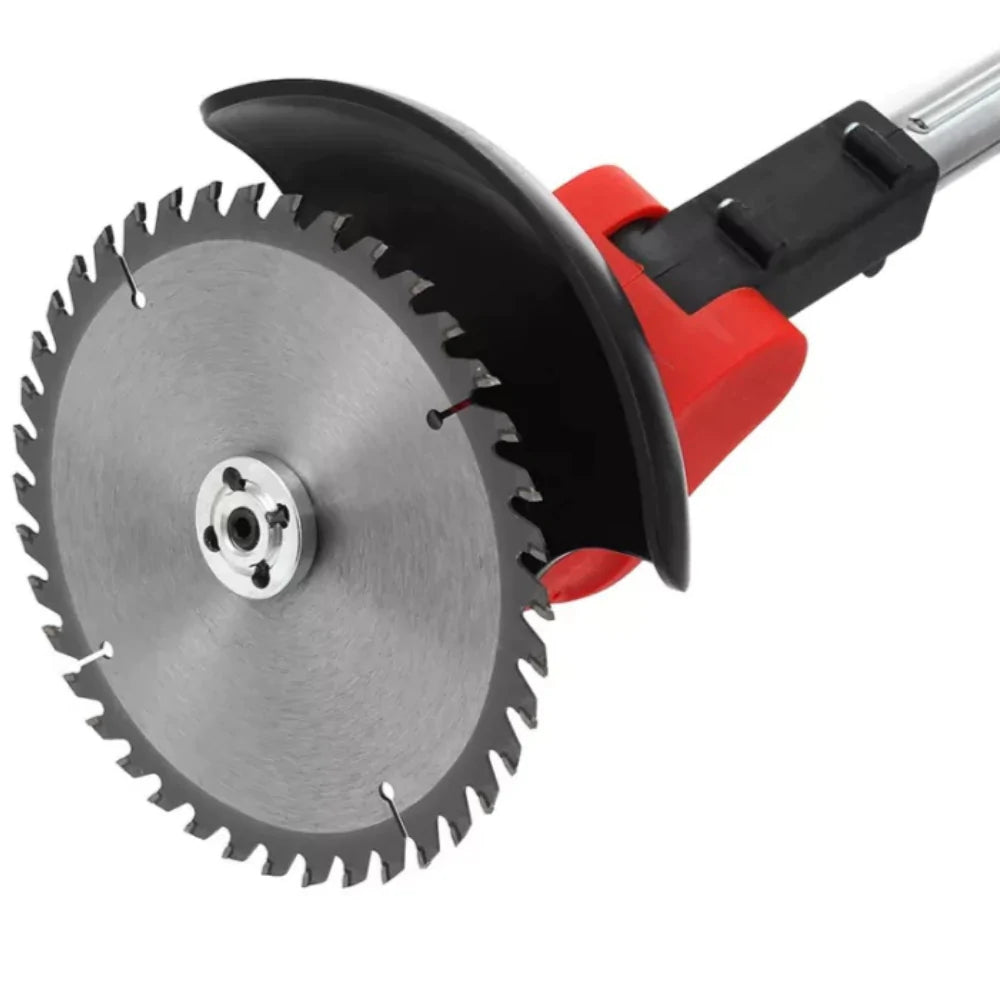


Choosing the right weed eater is not only about battery voltage, cutting speed, or blade type. The way you support and control the tool can also affect your trimming experience.
Some cordless weed eaters come with support wheels, while others are designed for handheld use. A weed eater with wheels can provide added ground support and help maintain a steadier cutting position. A weed eater without wheels, however, may offer greater freedom of movement around obstacles and uneven areas.
So, which option is better for your yard?
The answer depends on your yard layout, the type of trimming you do, and whether you prioritize stability or maneuverability. This guide compares both designs to help you choose the right configuration.

What Is a Weed Eater With Wheels?
A weed eater with wheels includes a wheel attachment near the cutting head. The wheels support part of the tool while allowing the cutting head to move across the ground.
Depending on the tool’s design and approved setup, wheels may be useful for:
-
Maintaining a more consistent cutting position
-
Guiding the tool across open areas
-
Reducing the need to hold the entire tool above the ground
-
Improving stability during routine grass trimming
-
Making straight passes easier to control
The wheels do not increase the motor’s cutting power. They change how the weed eater is supported and moved during operation.
What Is a Weed Eater Without Wheels?
A weed eater without wheels is controlled entirely by the operator. You hold and guide the cutting head without relying on a ground-support attachment.
This setup allows you to move the tool more freely in different directions and adjust its cutting position as needed.
A wheel-free weed eater may be useful for:
-
Trimming around trees and flower beds
-
Reaching narrow spaces
-
Working beside fences and walls
-
Cutting around landscaping features
-
Handling sloped or uneven sections
-
Changing cutting angles frequently
The main trade-off is that the operator must support and control the tool throughout the job.

Weed Eater With Wheels vs. Without Wheels: Quick Comparison
|
Feature |
With Wheels |
Without Wheels |
|
Ground support |
More |
Less |
|
Stability |
Generally steadier |
Depends more on operator control |
|
Freedom of movement |
More limited |
Greater |
|
Open, level areas |
Convenient |
Suitable |
|
Tight spaces |
May be less convenient |
Often easier |
|
Uneven ground |
Wheels may lose consistent contact |
Easier to reposition manually |
|
Cutting height control |
Can help maintain a steady position |
Requires manual control |
|
Storage |
Attachment may require more room |
Usually more compact |
|
User effort |
May reduce the need to support the cutting head |
Tool is fully supported by the user |
|
Best use |
Straight, controlled passes |
Detailed and flexible trimming |
Neither design is universally better. Each one solves a different type of yard-maintenance problem.
Advantages of a Weed Eater With Wheels
1. Added stability
The main advantage of wheels is ground support. They can help steady the cutting head while moving across a relatively level surface.
This may be helpful for users who find it difficult to keep a handheld cutting head at a consistent position.
2. More consistent movement
When the wheels remain in contact with even ground, they can guide the tool along a more predictable path. This can be useful for controlled passes over grass or weeds.
Results still depend on the terrain, cutting attachment, and how the tool is operated.
3. Less need to support the cutting head
A wheel attachment supports part of the tool near the ground. This may make routine trimming feel more manageable than continuously holding the cutting head in position.
The amount of benefit will vary by user, tool balance, handle adjustment, and yard conditions.

4. Helpful for open areas
Wheels can be convenient when trimming accessible sections with enough room to move the tool forward. They may be especially useful where there are fewer obstacles and sudden direction changes.
Limitations of a Weed Eater With Wheels
Wheels can improve stability, but they are not ideal for every situation.
1. Reduced maneuverability
A wheel attachment can limit how freely you change the angle or direction of the cutting head. Moving around closely spaced plants, trees, or landscaping features may require extra repositioning.
2. Less effective on uneven terrain
Wheels work best when they can maintain stable contact with the ground. On bumpy, rocky, sloped, or deeply rutted surfaces, they may not move smoothly.
3. Harder to access narrow spaces
The additional width of the wheel assembly may make it difficult to enter narrow gaps beside walls, fences, garden borders, or outdoor structures.
4. The wheels do not add cutting power
A weed eater with wheels is not automatically stronger than the same model without wheels. Cutting performance still depends on factors such as:
-
Motor design
-
Cutting speed
-
Battery charge
-
Cutting attachment
-
Vegetation type
-
Operating technique
Wheels provide support and guidance-not additional motor power.

Advantages of a Weed Eater Without Wheels
1. Greater freedom of movement
Without a wheel attachment, you can guide the cutting head in different directions and adjust its position more easily.
This flexibility is valuable in yards with many obstacles or irregularly shaped areas.
2. Better access around obstacles
A wheel-free setup may be easier to use around:
-
Trees
-
Fence posts
-
Raised garden beds
-
Shrubs
-
Outdoor furniture
-
Walkways
-
Lawn decorations
It allows the operator to approach these areas from different angles.
3. Easier repositioning on uneven ground
Instead of depending on wheels to stay in contact with the ground, you can manually raise, lower, or tilt the cutting head as the terrain changes.
This can make a wheel-free configuration more practical for slopes, corners, and uneven sections.
4. More compact configuration
Removing the wheels can make the lower section of the weed eater less bulky. This may help when transporting or storing the tool.
Limitations of a Weed Eater Without Wheels
1. More manual control is required
Without wheels, the operator must control the cutting position throughout the job. This can make it harder to maintain a consistent height or path.
2. The user supports the tool
The wheels cannot share the support load when they are not installed. Tool balance, handle position, technique, and the length of the cutting session can affect user comfort.
3. Results depend more on technique
The cutting head may move too high or too close to the ground if the operator does not maintain a steady position. Careful handling is particularly important around plants and hard surfaces.
Which Is Better for a Small Yard?
For a small yard, either configuration can work. The better choice depends more on the yard layout than its total size.

A weed eater with wheels may be suitable when:
-
Most of the surface is flat
-
The trimming area is open
-
You prefer added ground support
-
You want controlled, straight movement
A weed eater without wheels may be better when:
-
The yard contains many trees or flower beds
-
You need to enter narrow spaces
-
The ground is uneven
-
Most of the work involves detail trimming
A small yard with many obstacles may benefit more from maneuverability than from wheel support.
Which Is Better for a Large Yard?
A wheeled configuration can be convenient for accessible, relatively level sections where the tool can move in longer passes.
However, yard size alone should not determine the choice. For a large yard, you should also consider:
-
Battery runtime
-
Number of batteries
-
Density of the vegetation
-
Number of obstacles
-
Ground conditions
-
Length of each trimming session
For example, the Grazer 24V Cordless Weed Cutter provides an approximate runtime of 25-30 minutes per 2000mAh battery. If your trimming work takes longer, a two-battery option can provide additional working time.
A second battery extends the available runtime, but it does not increase the tool’s cutting power.

Which Setup Is Better for Lawn Edges?
The answer depends on the tool’s approved configuration and your edging area.
Wheels may help guide the tool along a relatively straight, level path. A wheel-free setup offers more freedom to adjust the cutting angle and move around curved borders.
Before using any weed eater for edging:
-
Check that the configuration is intended for that use
-
Install only compatible attachments
-
Keep the cutting attachment away from concrete and other hard surfaces
-
Maintain control of the tool
-
Follow the manufacturer’s instructions
Do not assume every wheel or cutting attachment is designed for every edging task.
Which Setup Is Better for Uneven Ground?
A weed eater without wheels is generally more adaptable on uneven ground because the operator can manually reposition the cutting head.
Wheels may be less convenient on:
-
Rocky ground
-
Deep grass
-
Ruts and depressions
-
Steep slopes
-
Areas with exposed roots
-
Surfaces with frequent height changes
If the ground is only slightly uneven, wheels may still be usable. However, they may not maintain the same level of support throughout the area.

Can You Remove the Wheels From a Weed Eater?
This depends on the weed eater’s design. Some models are available with removable wheel attachments, allowing the user to select a wheeled or wheel-free configuration.
The Grazer 24V Cordless Weed Cutter is available in configurations that include wheels and configurations without wheels. Select the appropriate product option before purchasing and follow the supplied assembly instructions.
Never modify a wheel assembly or install unsupported parts. Incorrect installation could affect control and safe operation.
How to Choose Between Wheels and No Wheels
Ask the following questions before selecting a configuration.
Choose a weed eater with wheels if:
-
Your yard is mostly flat
-
You work mainly in open areas
-
You prefer more ground support
-
You want help maintaining a steady cutting position
-
Your work involves longer, controlled passes
Choose a weed eater without wheels if:
-
Your yard has many obstacles
-
You frequently trim in narrow spaces
-
Your ground is uneven or sloped
-
You need to change cutting angles often
-
Maneuverability is your main priority
Consider access to both configurations if:
-
Your yard contains open and detailed areas
-
Some sections are flat while others are uneven
-
Your trimming requirements change throughout the yard
-
The model is specifically designed for safe wheel attachment and removal
Safety Tips for Both Configurations

Whether you use wheels or not, safe operation should remain the priority.
-
Inspect the tool and cutting attachment before use.
-
Confirm that the wheels, handle, and attachment are correctly installed.
-
Remove stones, glass, wire, and other debris from the cutting area.
-
Keep other people and pets away while operating the tool.
-
Wear eye protection, long pants, and sturdy footwear.
-
Maintain control of the tool and avoid overreaching.
-
Keep the cutting attachment away from your body.
-
Do not use damaged or unsupported attachments.
-
Remove the battery before adjusting or inspecting the tool.
-
Follow the product manual and attachment instructions.
Weed Eater With Wheels vs. Without Wheels: Final Verdict
A weed eater with wheels is generally better for users who want added stability, ground support, and controlled movement across open, relatively level areas.
A weed eater without wheels is usually better for users who need greater maneuverability around obstacles, narrow spaces, slopes, and uneven ground.
The best option is not necessarily the one with more attachments. It is the one that matches your yard and the type of work you perform most often.
The Grazer 24V Cordless Weed Cutter is offered in wheel and non-wheel configurations, allowing buyers to choose according to their yard-maintenance needs. It features a 24V input, 21,000 RPM no-load speed, a 2000mAh lithium battery, and approximately 25-30 minutes of runtime per battery.
Explore the Grazer 24V Cordless Weed Cutter and select the wheel or non-wheel configuration that best fits your yard.
Frequently Asked Questions
Are weed eaters with wheels easier to use?
Wheels can provide additional ground support and help guide the tool on relatively flat surfaces. However, ease of use also depends on the yard, tool balance, handle adjustment, and the operator.
Do wheels make a weed eater more powerful?
No. Wheels do not increase voltage, motor speed, or cutting power. They support and guide the tool during operation.
Can a wheeled weed eater be used on uneven ground?
It may be usable on slightly uneven ground, but wheels generally work best on level surfaces. A wheel-free configuration may be easier to reposition over rough or sloped terrain.
Is a weed eater without wheels better around trees?
A wheel-free setup generally provides more freedom to maneuver around trees and other obstacles. Care must still be taken to avoid damaging bark, plants, and nearby objects.
Should I buy the Grazer Weed Cutter with wheels?
The wheel configuration may be suitable if you prefer added stability and mainly trim open, level areas. If your yard has tight spaces, obstacles, or uneven terrain, the non-wheel configuration may offer better maneuverability.